
The single-prompt problem
A general AI assistant answers a legal drafting request in one pass: it reads what you gave it, draws on whatever it learned in training, and writes. The result is fluent, and fluency is exactly what makes its errors hard to see. Typical failures in legal work:
- Invented or misattributed authority. Courts in Canada and elsewhere have already dealt with filings that cited cases which do not exist, or cited real cases for propositions they do not contain.
- Law from memory. A provision paraphrased, an old version quoted, a rule for one permit applied to another.
- Drifting facts. A date attached to the wrong event, an amount in the wrong currency, a family member who is not in the file.
- Silent gaps. A concern in the refusal that is never answered, or missing evidence papered over with confident prose.
The model is not being careless; it is doing what one pass of text generation does. The fix is structural.
Six principles of a specialised chain
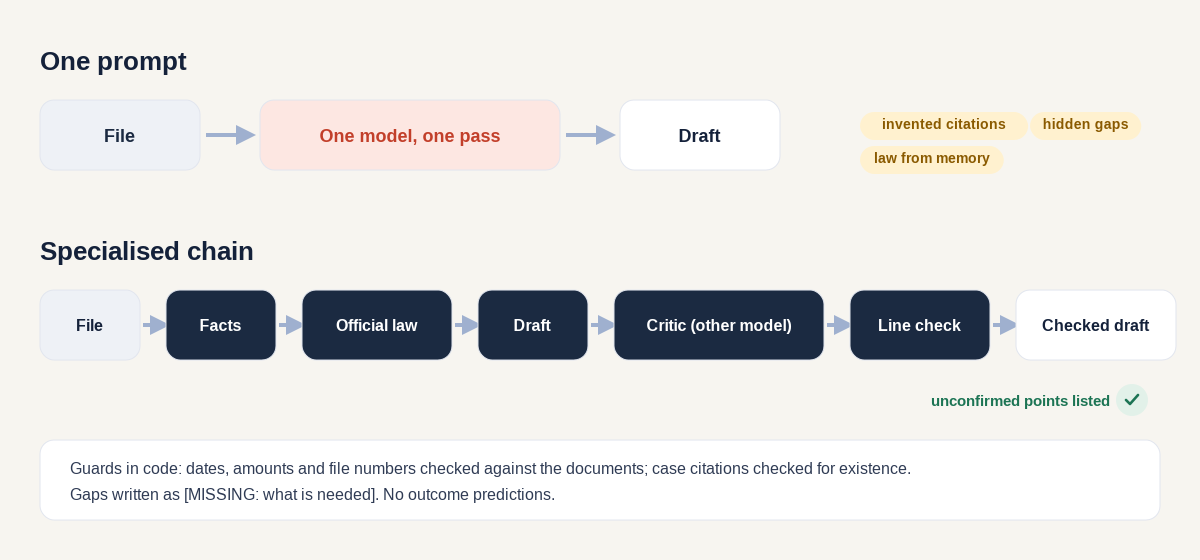
- Separate reading from writing. First extract the facts from the documents exactly as written. Later steps are checked against that list, not against the model's impression of the file.
- Ground the law in the official text. Retrieve the current consolidated provisions from the official source and give them to the writer word for word. Never rely on what a model remembers about a statute.
- Use a different model to criticise. A model reviewing its own draft tends to agree with itself. A critic from a different model family makes different mistakes, so it catches more of the writer's.
- Check every line, not just the whole. A line-by-line comparison against the documents and the law finds the wrong occupation or the wrong event that a general review skims past.
- Add deterministic guards. Dates, amounts, file numbers and case citations can be checked by ordinary code: is this date in the documents, does this citation exist. Code does not get tired or persuaded.
- Make uncertainty visible. Write
[MISSING: what is needed]instead of filling a gap, list every unconfirmed point, and never predict outcomes.
Side by side
| Question | General assistant, one prompt | Specialised chain |
|---|---|---|
| Where does the law come from? | Training memory | Official consolidated text, quoted |
| Who checks the draft? | Nobody, or the same model | A different model family, then every line |
| Are citations verified? | No | Existence checked; listed for you to read |
| What happens to gaps? | Filled with plausible text | Marked as missing and listed |
| Does it show what it could not confirm? | Rarely | Always, as a list |
| Is cost bounded? | Per subscription | Fixed budget per draft |
What a chain does not do
A chain reduces errors and makes the rest visible; it does not make a draft correct. An existing case can still be cited for the wrong point, an officer's reasoning can still be misread, and judgment about strategy remains the professional's. The value is that you start from a draft whose weak points are already marked, rather than one that hides them.
How CaseVane implements it
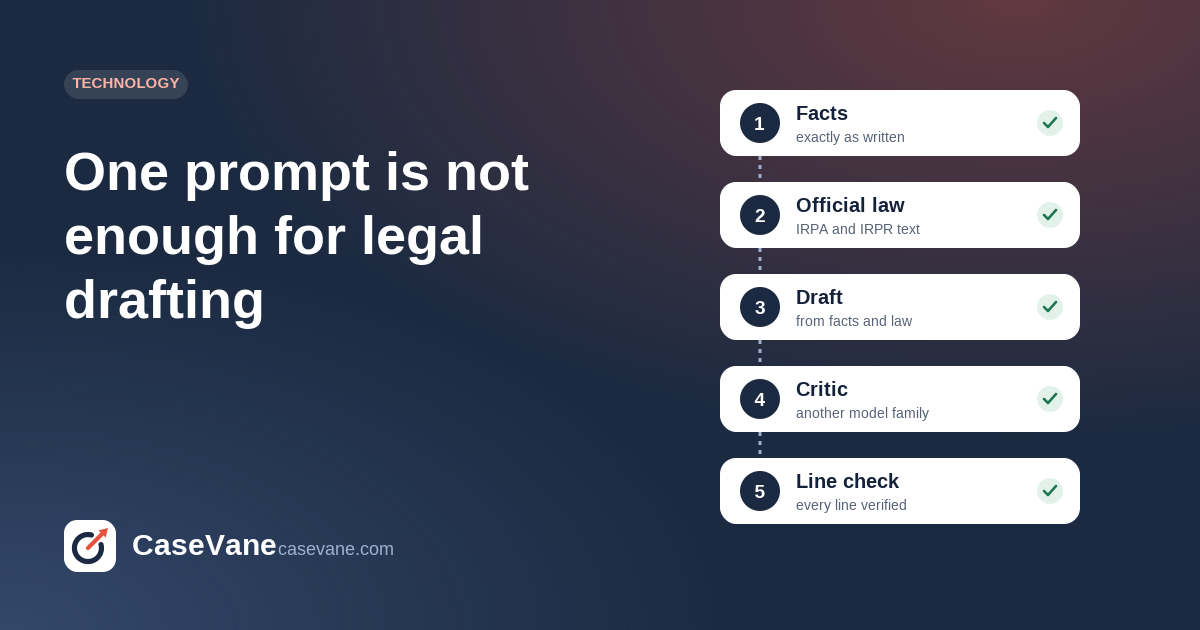
CaseVane runs five passes (fact extraction, official IRPA and IRPR text, drafting with an Anthropic Claude model, a critic and line check by Google Gemini models, and fact and citation guards) on de-identified text. The details are in inside the CaseVane pipeline, and you can read one unedited sample run with all its checks.
This article is general information for licensed professionals, not legal advice. Check the current text of the Act, the Regulations and IRCC's instructions before relying on any point.