
Why ask before the first upload
Once a client file has been sent to a service, it cannot be unsent. A few questions before the first upload tell you more than any marketing page: where the information goes, who can read it, how long it stays, and whether the output can be trusted. Ask them of every AI tool, including ours. A vague answer is an answer.
Your clients' data
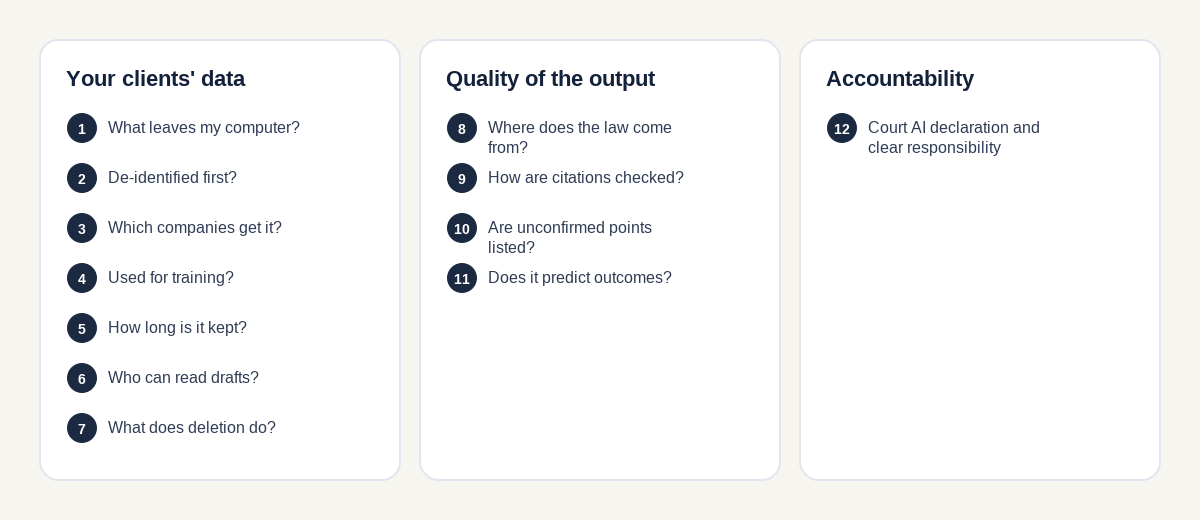
- What exactly leaves my computer? Whole files, extracted text, or de-identified text? A good answer is specific.
- Is anything de-identified before it is sent, and can I see the outgoing text? If not, the provider receives every name and number in the file.
- Which other companies receive it? Ask for the model providers and hosting sub-processors by name.
- Is it used to train models, by you or by them? Ask for the setting or contract term that guarantees the answer.
- How long is each copy kept? Inputs, outputs, logs and backups often have different periods.
- Who can read my finished drafts? If the service holds the keys, its staff or an attacker who reaches its database potentially can.
- What happens when I delete a draft or my account? Deleted, or only hidden?
The quality of the output
- Where does the law in a draft come from? The official current text, or the model's memory?
- How are case citations checked? At minimum, that each one exists; and the tool should tell you to read it.
- Does it show me what it could not confirm? A list of unsupported facts and lines is worth more than polish.
- Does it predict outcomes? It should not. Options and evidence, yes; a chance of success, no.
Accountability
- Does it help me meet court and regulator expectations? For example, the AI declaration the Federal Court's notice asks for in documents that contain AI-generated content, and clear terms that you remain responsible for what you file.
CaseVane's answers
| Question | CaseVane |
|---|---|
| 1. What leaves my computer | De-identified text only. PDFs are read in your browser and never uploaded. |
| 2. De-identified, and can I see it | Yes: an in-browser name-recognition model plus fixed patterns; you review and can hide more before sending. |
| 3. Other companies | OpenRouter, which passes the de-identified text to Anthropic's Claude and Google's Gemini models; CanLII receives citations only. |
| 4. Training | We never train on your documents; the line check is routed only to endpoints that do not use data for training. Providers handle the text under their own terms. |
| 5. Retention | De-identified text deleted when the draft finishes; sealed drafts deleted after 24 hours; optional passphrase vault up to 30 days. |
| 6. Who can read drafts | Only your browser tab: drafts are sealed with RSA-OAEP 3072 and AES-256-GCM to a key we never receive. |
| 7. Deletion | Deleting a draft removes its content; deleting your account removes all drafts. |
| 8. Source of law | The consolidated IRPA and IRPR from the Justice Laws Website, quoted, plus IRCC guidance where a service needs it. |
| 9. Citations | Each neutral citation is checked on CanLII for existence and listed for you to read. |
| 10. Unconfirmed points | Unsupported facts, unmatched lines and the critic's review come with every draft. |
| 11. Predictions | None. Drafts set out options. |
| 12. Court and terms | Federal Court documents carry the AI declaration at the top; our terms state that you review and remain responsible. |
The limits, so the answers are complete: automatic de-identification can miss a detail, and the de-identified text passes through our server and the model providers while a draft is written. The full detail is on the security page and in the privacy policy.
This article is general information for licensed professionals, not legal advice. Check the current text of the Act, the Regulations and IRCC's instructions before relying on any point.