
Why one prompt is not enough
Ask a single AI model to "analyse this refusal" and it will produce fluent text. The trouble is what fluent text hides: a date moved from one event to another, an amount whose currency changed, a regulation quoted from memory, a case that does not exist. In immigration work each of those is a real risk to a client.
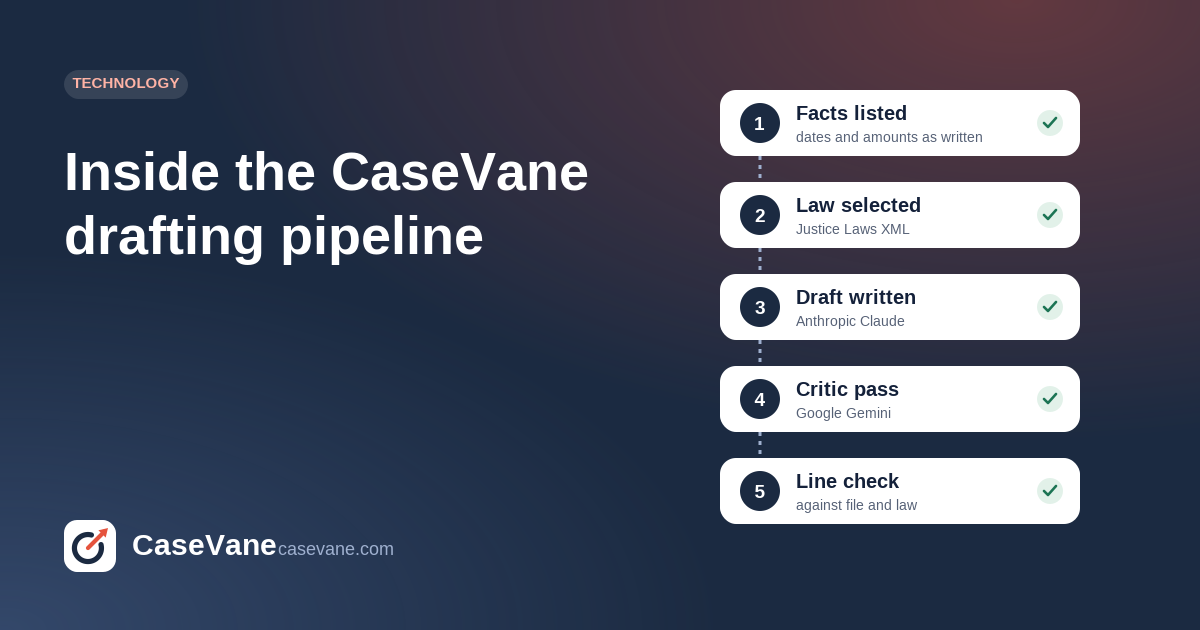
CaseVane treats the model as a capable drafter that must be checked, not as an authority. Every draft goes through five passes, and three separate guards report what could not be confirmed.
Pass 1: facts from your documents
A fast model reads the de-identified documents and lists the facts: dates, amounts, file numbers, events, relationships, each written exactly as it appears. Long or repetitive records, such as a bank statement, are summarised so the list stays usable. This list is what later passes are checked against.
Pass 2: the law from the official text
CaseVane does not ask a model to remember the law. It reads the consolidated Immigration and Refugee Protection Act and Immigration and Refugee Protection Regulations from the XML the Justice Laws Website publishes, keeping only current text, without amendment notes or schedules that reuse section numbers.
The sections your documents cite are taken first. Then rules add the provisions a type of refusal always needs: for a visitor who the officer believes will not leave, IRPA sections 20 and 22 and IRPR section 179; for a study permit, IRPR section 216; for a work permit, section 200; for extensions and restoration, sections 181 to 183; and IRPA section 72 for the route to the Federal Court. A reconsideration request also receives IRCC's own published instructions on reconsideration, quoted word for word with their page and date.
Pass 3: the draft
A strong Anthropic Claude model writes the draft for the service you chose: refusal analysis, procedural fairness response, submission letter or reconsideration request. It sees the original de-identified documents and the full text of the selected provisions, not summaries, because quotations can only be checked against originals.
The writing instructions are strict: use only the documents and the sources supplied, write [MISSING: what is needed] rather than filling a gap, set out options rather than a chance of success, and for documents meant for the Federal Court, start with the AI declaration the Court asks for.
Pass 4: a critic from a different model family
A model reviewing its own work tends to agree with itself. The critic in CaseVane is a Google Gemini model, a different family from the writer. It reads the draft against the original documents and the law, and lists every statement they do not support and every concern in the refusal left unanswered. If it finds a critical problem, the draft is marked Critic objected instead of ready. You receive the critic's full review next to the draft.
Pass 5: every line checked
Finally, each line of the draft is checked on its own against the documents and the legal sources. This catches errors that are not numbers at all: a wrong occupation, the wrong event, a document the file does not contain, a provision that says something else. Lines that cannot be matched are listed for you to read. Worked-out arithmetic counts as supported, and a section that already lists gaps is not flagged twice.
The guards around the passes
- Fact guard. Every date, amount, file number, name and marital status in the draft is compared with the documents. One that is not there is listed and the draft is held for checking. It also notices an amount whose currency changed and a date attached to the wrong event, such as an application date given as the refusal date.
- Citation guard. Each neutral citation, such as
2024 FC 123, is looked up on CanLII to confirm the case exists. Only the citation is sent. Existence is not support, so you still read the case. - Cost and time limits. Each draft runs under a fixed budget, and a draft that fails or is stopped does not count toward your month.
What you receive
A working draft with a status (ready, check these points first, or critic objected), the list of facts not found, the lines to check, the cited cases and whether each was found, and the critic's review. It is sealed to your browser tab and can be downloaded as Word or plain text. A typical draft takes a few minutes.
See the whole output, unedited, in the sample analysis of a fictional visitor visa refusal.
This article is general information for licensed professionals, not legal advice. Check the current text of the Act, the Regulations and IRCC's instructions before relying on any point.