
Two routes after a refusal
When an IRCC officer refuses an application and the refusal seems to have missed something already in the file, two routes are open at the same time:
- A reconsideration request to the office that decided, asking the officer to look at the decision again.
- An application for leave and judicial review in the Federal Court, asking the Court to set the decision aside.
They are not alternatives in sequence. The Federal Court deadline runs from the decision, whatever happens to a reconsideration request.
The Federal Court deadline
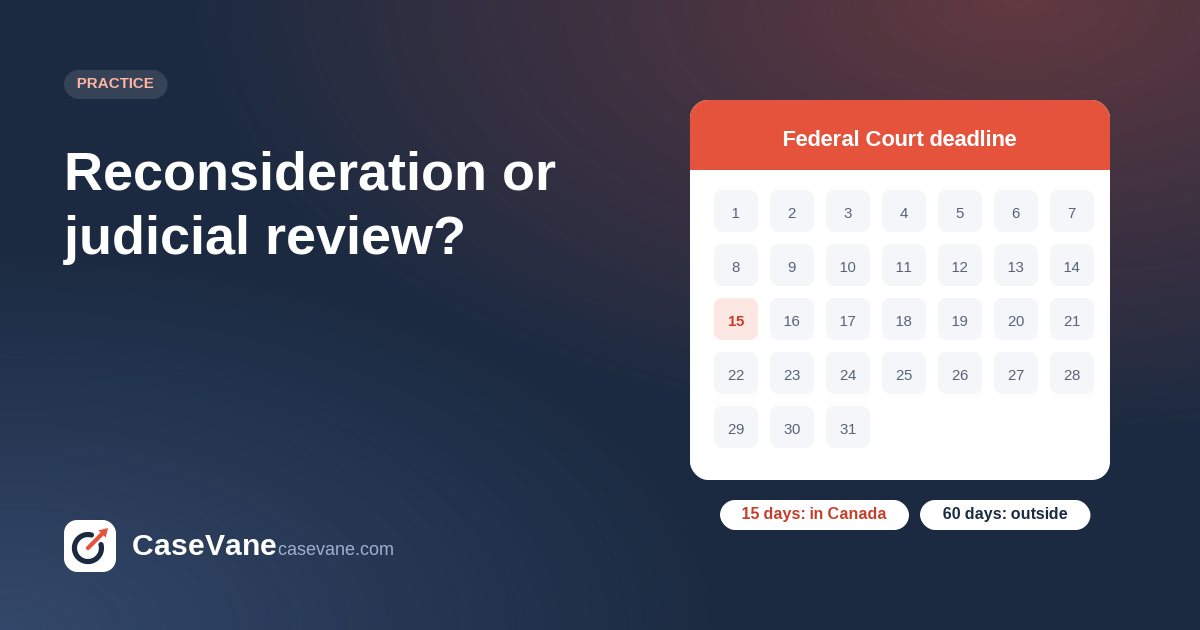
Under section 72 of the Immigration and Refugee Protection Act, judicial review of an immigration decision requires leave of the Court. Paragraph 72(2)(b) sets the time to file and serve the application for leave: 15 days after the applicant is notified of or otherwise becomes aware of the matter if it arose in Canada, and 60 days if it arose outside Canada. A judge may allow more time for special reasons, but that is an exception to be argued, not a plan.
In practice that means computing both dates from the decision date in the refusal letter, and putting them at the top of the file on day one.
What IRCC says about reconsideration
IRCC's program delivery instructions, "Reconsideration after refusal", set out how officers handle these requests:
- When an office receives a request to reconsider, an officer must consider it and decide whether to exercise their discretion to reconsider.
- The doctrine of functus officio does not automatically bar reconsideration of a final decision; the instructions cite Kurukkal, 2010 FCA 230.
- Reconsideration should be done only where warranted, in exceptional cases. An applicant's dissatisfaction or disagreement with the decision is not, on its own, a reason.
- Requests should go back to the original decision maker when possible, and the request, the decision and its reasons are recorded in GCMS notes.
So a strong request is narrow and concrete: it shows that specific evidence already before the officer was overlooked or misread, and why that matters to the stated ground. It is not a second, longer application.
How the two interact
- A request does not stop the clock. Waiting weeks for an answer can use up the whole leave period.
- The answer is itself a decision. A refusal to reconsider is a separate decision, which has its own review questions; it does not reopen the time to challenge the original refusal.
- Plan both from the start. If the file may go to Court, prepare that work in parallel with the request, rather than after it.
A practical structure for the request
- Identify the decision: date, office, application type, and the deadlines under s. 72.
- Quote each concern from the refusal letter and the officer's notes.
- For each concern, point to the evidence that was already in the file, by document and page.
- Explain briefly why that evidence answers the concern, without new arguments the officer could not have considered.
- List what is genuinely missing, so the client can decide whether a new application is the better route.
- Ask for the specific outcome: that the decision be reconsidered by the original decision maker.
CaseVane's reconsideration request service follows this structure: it maps each concern to the evidence on file, lists what is missing, and puts both Federal Court deadlines first, grounded in IRCC's instructions quoted word for word. You review and adopt every line.
This article is general information for licensed professionals, not legal advice. Check the current text of the Act, the Regulations and IRCC's instructions before relying on any point.